-
LatestThe best Speaker of 2026
-
 Ultimate Ears Megaboom 4 Rugged 360-degree Bluetooth sound for outdoor gatherings
-
 Ultimate Ears Boom 4 Rugged 360-degree portable sound for gatherings anywhere.
-
 Ultimate Ears Wonderboom 4 Rugged, compact Bluetooth sound for everyday outdoor adventures.
-
 Turtlebox Ranger Rugged, loud portable speaker built for outdoor adventures.
-
 House of Marley Get Together 3 Portable speaker with warm sound and sustainable materials
-
 Turtlebox Original Gen 3 Rugged, powerful outdoor sound built for all-day adventures.
-
-
LatestThe best Speaker of 2026
-
 Onkyo GX-10DB Compact powered desktop speakers with versatile everyday connectivity
-
 Onkyo GX-30ARC Versatile powered stereo speakers for desks and TVs
-
 Audioengine HD6 Rich, flexible stereo sound without a separate amplifier.
-
 Mackie CR8BT Large, bass-rich desktop speakers for studios, gaming, and everyday listening.
-
 Mackie CR5BT Versatile Bluetooth monitors for music, work, and production.
-
 KEF LSX II LT Compact powered speakers with streaming and HDMI ARC
-
-
LatestThe best Speaker of 2026
-
 Yamaha NS-F 51 Smooth, affordable floorstanders for music and movie nights
-
 Q Acoustics 5040 Floorstanders deliver clear vocals, controlled bass, spacious sound.
-
 Q Acoustics 3050i Hifi Warm, room-filling floorstanders for music and movie nights.
-
 Q Acoustics M40 Room-filling stereo sound with simple all-in-one connectivity.
-
 Polk Audio T50 Warm, affordable towers for music and home theater
-
 KEF Q550 Slim towers, clear vocals, spacious imaging, controlled bass.
-
-
LatestThe best Speaker of 2026
-
 Logitech Z207 2.0 Compact Bluetooth desktop speakers for clear everyday audio
-
 Edifier G2000 Compact gaming speakers with connectivity and RGB lighting
-
 Edifier R1855DB Fuller desktop sound with flexible wired and wireless connectivity.
-
 Edifier R1280T Affordable powered speakers offer warm, clear everyday sound.
-
 Audioengine A2+ Compact powered speakers deliver clear, flexible desktop sound.
-
 Logitech Z313 Compact 2.1 desktop speakers deliver fuller everyday audio.
-
-
LatestThe best Headphone of 2026
-
 Sony 1000X THE COLLEXION Zwart Foldable noise-cancelling headphones with rich sound and comfort
-
 Bose QuietComfort Ultra Headphones (Gen 2) Premium travel audio: immersive sound, comfort, powerful cancellation.
-
 Sony WH-1000XM6 Premium noise-cancelling headphones for travel, work, and comfort.
-
 JBL Tour One M3 Smart TX Premium noise-cancelling headphones with a travel-ready audio transmitter
-
 Cleer Audio Enduro ANC Affordable headphones with cancellation and marathon battery life
-
 Cleer Audio Alpha Detailed sound, strong noise cancellation, and all-day battery life.
-
-
LatestThe best Headphone of 2026
-
 Jabra Evolve 20SE UC Stereo Lightweight wired headset for clear everyday office calls
-
 Jabra Evolve 40 UC Wired headset delivers clear calls and convenient controls
-
 Philips TAH4205 Compact wireless headphones with punchy bass and quick charging
-
 Jabra Evolve2 65 Flex MS Foldable Teams headset for clear, portable hybrid-work calls.
-
 JBL JR310BT Kid-friendly wireless audio with an 85 dB limit
-
 Sony WH-CH520 Lightweight headphones, long battery life, effortless pairing.
-
-
LatestThe best Headphone of 2026
-
 Cleer Audio ARC 3 Open-ear comfort, rich features, everyday awareness.
-
 Samsung Buds FE Affordable everyday earbuds with ANC and a secure fit
-
 Sennheiser Momentum Sport Workout earbuds with heart-rate tracking and punchy sound
-
 Sony LinkBuds Fit Comfortable, secure earbuds for commutes and workouts.
-
 JBL Live Buds 3 Feature-rich earbuds with touchscreen case and customizable sound.
-
 Bowers & Wilkins Pi8 Premium earbuds offer detailed sound and travel-ready versatility
-
-
LatestThe best Headphone of 2026
-
 HyperX Cloud Alpha Wireless A long-lasting gaming headset built for marathon sessions.
-
 Razer Kraken V4 Feature-rich wireless gaming headset for multi-device play
-
 Turtle Beach Stealth 700 GEN3 Flexible gaming audio, Bluetooth, and exceptional battery endurance.
-
 Logitech G535 Lightspeed Wireless Lightweight comfort and reliable PC, PlayStation gaming audio
-
 Corsair Void RGB Elite Wireless Comfortable PC gaming headset with punchy audio
-
 Corsair HS80 RGB Wireless Comfortable gaming headset with clear audio and microphone
-
-
LatestThe best Home audio system of 2026
-
 Sony Bravia Theatre Bar 8 Premium Dolby Atmos sound with a tidy, expandable single-bar design.
-
 TCL S45H 2.0 Compact budget soundbar boosts dialogue with virtual surround.
-
 TCL S55H 2.1 Compact soundbar delivers clearer dialogue, cinematic sound, and wireless bass.
-
 TCL Q85H Immersive Dolby Atmos cinema sound, without receiver hassle.
-
 Harman Kardon Enchant 1100 Premium soundbar brings immersive cinema and clear dialogue
-
 Harman Kardon Enchant 900 Compact Atmos soundbar with clear dialogue and spacious sound.
-
-
LatestThe best Home audio system of 2026
-
 Google TV Streamer 4K Polished streaming and smart-home hub for everyday viewing
-
 Apple TV 4K (Wi-Fi) Premium streaming with polished menus and seamless integration.
-
 Nvidia Shield TV Pro Versatile 4K streamer for local media and gaming
-
-
LatestThe best Home audio system of 2026
-
 Pioneer VSX-LX305 Immersive nine-channel home theater with Dirac Live correction.
-
 Denon AVC-X3800H Expandable home theater power with Atmos and gaming connectivity.
-
 Pioneer VSX-LX505 Flexible Atmos receiver with Dirac Live, gaming support
-
 JBL MA510 Straightforward 5.2-channel home theater with modern gaming connectivity.
-
 JBL MA310 Straightforward 5.2-channel surround sound for 4K home theaters
-
 Denon AVR-S970H Flexible 7.2-channel receiver for immersive, modern home theaters
-
-
LatestThe best Home audio system of 2026
-
 Denon PMA-1700NE Versatile stereo amp for vinyl and digital music
-
 Pioneer A-40AE Balanced stereo sound, versatile analog and digital connections.
-
 Audiolab 6000A Versatile stereo amplification with clear sound and connectivity
-
 Denon PMA-900HNE Streaming stereo amplifier for vinyl, TV, and playlists
-
 LEAK Stereo 130 Versatile, stylish amplifier for vinyl, digital audio, and Bluetooth.
-
 Yamaha A-S701 Powerful, versatile stereo amplification for traditional home hi-fi.
-
-
LatestThe best Home audio system of 2026
-
 Mackie CR8S Compact studio subwoofer adds controlled low-end depth to nearfield monitors.
-
 Audioengine S8 Compact powered subwoofer adds balanced bass to small stereo setups.
-
 KEF Kube 12 MIE Active Subwoofer Controlled, room-filling bass for music and cinematic impact.
-
 Klipsch R-12SW Powerful, room-filling bass for movies and music.
-
 Klipsch R-121SW Powerful, room-filling bass for movies and music.
-
 Bose Bass Module 500 Compact subwoofer adds fuller sound to compatible soundbars.
-
Pioneer VSX-LX305 review
Review the Pioneer VSX-LX305, a 9.2-channel AV receiver with Dolby Atmos, Dirac Live room correction, HDMI 2.1 gaming features and versatile streaming.
check best price


 2025-02-16
- By Tamar Pluimgraaf
Summary / TL;DR

The Pioneer VSX-LX305 is a nine-channel AV receiver that supports immersive layouts such as 5.1.4 and 7.1.2 without an external amplifier. It includes Dirac Live room correction, Dolby Atmos support, seven HDMI inputs and two outputs, with six inputs handling 4K/120Hz and 8K/60Hz signals. AirPlay 2, Chromecast, Bluetooth and other streaming options provide flexible music playback.
Setup is guided, but Dirac calibration takes time and careful microphone placement. The receiver’s full-size chassis also needs adequate shelf space and ventilation. Its nine internal amplifier channels cannot power a 7.1.4 layout alone, and advanced multi-subwoofer setups may be better served by a receiver with more independent outputs. The LX305 is most relevant to buyers building a capable surround system; simpler TV setups may not need its extra features.
If you like this review, you might also like our review on the Pioneer VSX-LX505.
Where to buy
 Best offers of the Pioneer VSX-LX305 at Amazon.com
Want to help us grow? When you purchase items through the above links we receive a small commission.
Introduction
The Pioneer VSX-LX305 is a 9.2-channel home theater receiver aimed at people who want immersive surround sound without jumping straight to a separate power amplifier. Its nine built-in channels can support setups such as 5.2.4 Dolby Atmos—five speakers around the room, two subwoofers, and four height speakers—or 7.2.2. That gives you room to build a proper cinema system rather than simply replace a stereo receiver.
Its appeal isn’t just the channel count. The LX305 combines support for modern surround formats and HDMI 2.1 features with Dirac Live room correction, which helps address the way walls, furniture, and speaker placement affect sound. In a real living room, where the sofa may have to sit close to a back wall and the speakers can’t always go in ideal positions, that flexibility can matter as much as the receiver’s headline specs. This review looks at what the Pioneer does well, and where its features may be more than a simple setup needs.
Related reviews


Design and Build Quality
The Pioneer VSX-LX305 has the broad, low-profile shape you’d expect from a full-size home theater receiver, with a matte-black finish that blends in beside most AV components. It measures about 435 × 173 × 370 mm and weighs roughly 10.3 kg. That’s substantial enough to feel like proper rack-sized gear, but still manageable for one person to lift onto a sturdy shelf.
A straightforward front panel
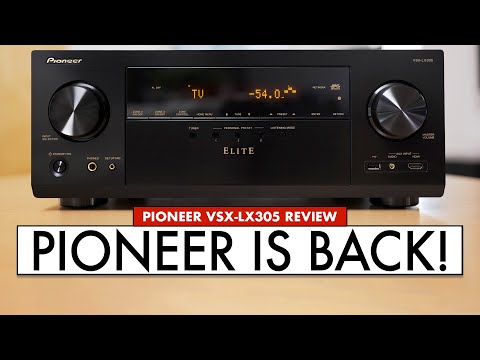
The front keeps things practical rather than flashy. A central display sits between the main controls, including a large volume dial and an input selector. Smaller buttons and a front USB port are grouped nearby, so basic tasks don’t require digging through the menus. The display is useful from across a room, though its compact text can be harder to read from a low seating position.
Look closely and the design is more functional than luxurious: there’s no hinged front panel hiding the controls, and the finish doesn’t try to imitate premium brushed metal. Still, the layout feels orderly, and the prominent dials are easy to find by touch in a dim room.
Allow room for ventilation
The cabinet has ventilation openings across the top, so avoid placing another component directly on it or squeezing it into a tight cabinet. In a typical setup, leaving open space above the receiver is a sensible trade-off for its full-size footprint. The overall build is solid, though its wide, deep chassis means you’ll want to measure your shelf before buying—especially if cables need extra clearance behind it.
What's in the Box
The box includes the receiver and the basic accessories needed to get a system connected and ready for setup. For the Pioneer VSX-LX305, that typically means:
- Remote control and two AAA batteries
- Speaker setup microphone for the receiver’s automatic room calibration
- FM wire antenna and AM loop antenna
- Power cord and quick-start documentation
The calibration microphone is the most useful item beyond the usual remote and power lead. Put it at your main seat, roughly at ear height, before running setup; balancing it on a cushion can leave it sitting too low. The antenna wires are simple indoor models, so you may need to move them around to get clearer radio reception. Accessories can vary by sales region, so check the listing if you’re buying a model shipped from another country.
Setup and Ease of Use
The initial setup is guided by an on-screen assistant that walks through speaker connections, input assignments and network access. It’s a useful safety net if you’re wiring a surround system for the first time: the receiver asks which speakers you have rather than expecting you to know every menu setting in advance. The Pioneer VSX-LX305 supports layouts such as 5.2.4 and 7.2.2, so it helps to decide where the height speakers will go before you start plugging cables in.
Dirac Live takes a little patience
Room calibration uses the included microphone and Dirac Live. You’ll need to connect the receiver and your phone or computer to the same home network, then follow the app’s measurement prompts. For a better result, place the microphone at ear height on a stand; balancing it on the sofa while you measure several seating positions is possible, but not ideal. The process takes longer than a quick one-position setup, especially if you’re checking a full surround layout, but the prompts make the steps manageable.
One small catch: calibration is more involved than pressing a single button on the receiver. You’ll move the microphone between listening positions and may want to revisit the measurements if the first pass sounds off. That extra effort suits people who like to fine-tune a system, though anyone wanting a fast plug-and-play setup may find it a bit fiddly. Once calibration is saved, everyday operation is much simpler; you generally won’t need to repeat the process unless you move speakers or change the room.
Audio Performance and Room Correction
The receiver’s nine-channel amplification gives you room for a 5.1.4 Dolby Atmos setup without adding a separate power amp. Its rated output is 100 watts per channel into 8 ohms, measured with two channels driven; that figure is useful for comparison, but it doesn’t mean all nine channels can deliver 100 watts at once. With a full set of speakers playing a loud action scene, the available power is shared across the system.
For films, effects pan cleanly between speakers, while dialogue stays easy to follow when the mix gets busy. A helicopter moving overhead in an Atmos soundtrack, for example, can travel from the front height speakers to the rear without sounding like two separate effects. Stereo music also comes across with good detail, though the final balance depends heavily on the speakers and room.
Dirac Live room correction
Dirac Live is the main tool for tuning the sound to your room. The included limited-bandwidth version corrects frequencies up to around 500Hz, where room reflections and standing waves often cause uneven bass and lower-midrange response. Dirac also works on timing and impulse response, so its job goes beyond simply boosting or cutting certain frequencies. A full-bandwidth upgrade is available separately.
In a typical living room, calibration can help tame a bass note that booms whenever an explosion hits, or smooth out the muddy sound that builds up near a wall. It won’t fix a poor speaker position or remove a room’s echo, but it can make the system sound more even from the main listening seat. Take measurements at several nearby seats rather than only the exact center, and keep the microphone clear of cushions and table surfaces.
The two subwoofer outputs give you flexibility when placing a pair of subs, and a Dirac Live Bass Control upgrade is available for more advanced subwoofer integration. The standard room-correction setup still takes some care: accurate measurements matter, and the correction won’t necessarily make every seat sound identical. For a first-time user, the software has more steps than a quick automatic calibration, but the extra control is worthwhile if you’re trying to get consistent bass and clear dialogue from a multichannel home theater.
Video and Connectivity
The HDMI connections are the main reason to consider the Pioneer VSX-LX305 for a modern TV and game console setup. It has seven HDMI inputs: six support 8K/60Hz and 4K/120Hz signals, while the seventh handles up to 4K/60Hz. That gives you room to connect a PS5 or Xbox Series X, a 4K Blu-ray player and a streaming box without constantly swapping cables.
HDMI 2.1 for gaming and 8K video
The HDMI 2.1 inputs support VRR (which helps reduce screen tearing), ALLM (which lets a compatible TV switch to its low-latency game mode) and QFT. For example, connect a 4K/120Hz console to one of the six higher-bandwidth inputs and the receiver can pass the signal to a compatible TV. The receiver also supports HDR10, HDR10+, Dolby Vision and HLG, so it can pass through common HDR formats from a player or streaming device.
There are two HDMI outputs, including an eARC connection for sending audio from TV apps back to the receiver. A practical setup is to connect your console and disc player to the receiver, then run one HDMI cable to the TV; eARC is handy if you also watch apps built into the TV. Check that the source is connected to one of the six 8K/4K/120Hz inputs if you want high-refresh-rate gaming—the seventh input is limited to 4K/60Hz.
Useful connections beyond HDMI
For older gear, the back panel includes optical and coaxial digital audio inputs, plus analog RCA connections and a phono input for a turntable. Ethernet provides a wired network option, and the front USB port is useful for compatible USB playback or accessories. Overall, the connection selection covers a mixed system well, though the split between high-refresh and standard HDMI inputs is worth checking before you plug everything in.
Streaming and Smart Features
The Pioneer VSX-LX305 gives you several ways to play music without turning on a TV. Chromecast built-in makes it easy to cast from supported apps on an Android phone, while Apple AirPlay 2 handles streaming from iPhones, iPads and Macs. If you’re playing a playlist while making dinner, you can send it straight to the receiver rather than relying on a Bluetooth connection.
Streaming options and smart-home links
DTS Play-Fi adds another route, with its app bringing supported music services and internet radio together. The available services depend on your region, and you’ll need the Play-Fi app for that setup. The receiver is also Roon Tested, a useful fit for listeners who keep a computer- or NAS-based music library and manage it through Roon.
- Spotify Connect: Start playback in Spotify and choose the receiver as the playback device.
- AirPlay 2: Send audio from Apple devices and group compatible speakers for multi-room playback.
- Works with Sonos: Integrate it with a compatible Sonos component, such as a Port, and control playback through the Sonos system.
- Bluetooth: A handy fallback for quick playback when you don’t want to open a streaming app or configure a network connection.
In everyday use, the choice is welcome, but it does mean switching between apps: Spotify Connect is simplest for Spotify, while Play-Fi suits other supported services. For reliable casting, connect the receiver and phone to the same home network; Bluetooth is easier for a quick guest playlist, though it lacks the broader multi-room control of AirPlay 2 or Play-Fi.
Competitor comparison
The Pioneer VSX-LX305 sits in a useful middle ground: it offers nine channels of amplification and built-in Dirac Live room correction without the price jump to more elaborate receivers. Its closest rivals are the Onkyo TX-RZ50 and Denon AVR-X3800H. The best fit depends less on headline wattage than on how many speakers and subwoofers you plan to connect.
| Receiver | What sets it apart | Best fit |
|---|---|---|
| Pioneer VSX-LX305 | Nine amplified channels; Dirac Live included | A 5.1.4 or 7.1.2 setup with room correction in the box |
| Onkyo TX-RZ50 | Nine amplified channels; Dirac Live and THX certification | Buyers comparing closely matched home-theater receivers |
| Denon AVR-X3800H | Nine amplified channels, processing for up to 11.4 channels, and four independent subwoofer outputs | More complex systems or plans to add extra amplification |
Pioneer vs. Onkyo TX-RZ50
The TX-RZ50 is the most direct alternative. Both receivers support nine powered channels and include Dirac Live, so either can run layouts such as 5.1.4 Dolby Atmos without an external power amp. Onkyo adds THX certification, which may appeal to buyers who like that extra assurance for home-cinema use. In practice, the choice often comes down to price, availability, and which receiver’s controls and connections suit your rack. If they’re similarly priced, the Pioneer remains a strong pick for getting Dirac Live without paying for a separate correction upgrade.
Pioneer vs. Denon AVR-X3800H
The Denon costs more, but gives you a clearer upgrade path. It can process up to 11.4 channels, while its nine internal amplifier channels mean you’d need an external stereo amp to use an 11-channel speaker layout. Its four independent subwoofer outputs are useful in a large room where bass varies between seats; the Pioneer is a simpler match for a conventional one- or two-subwoofer setup. Denon also lets you add Dirac Live with a separate license, whereas the Pioneer includes it. That difference can make the Pioneer the better value if room correction is high on your list.
For a typical living-room theater with four height speakers, the Pioneer and Onkyo offer the main features most people will use right away. Choose the Denon if you expect to expand beyond nine powered channels or need finer control over several subwoofers. For a nine-channel AV receiver with Dirac Live included, the Pioneer is the more straightforward buy.
Conclusion
The Pioneer VSX-LX305 is a strong choice for a 9.2-channel AV receiver that can grow with a serious home theater setup. Its nine amplified channels support layouts such as 5.1.4 or 7.1.2, so you can add overhead speakers without immediately stepping up to a much pricier receiver. That flexibility is useful in a real room, where a pair of ceiling speakers may be a more practical upgrade than replacing the whole system.
Its main appeal is the combination of Dolby Atmos support, Dirac Live room correction and modern HDMI features in one receiver. Dirac can help tame uneven bass and distracting room effects, though getting the best result takes some patience with speaker placement and calibration. The trade-off is that this is a substantial investment, and its nine built-in amplifier channels won’t power a 7.1.4 system on their own.
For movie fans building a flexible surround sound system, the VSX-LX305 is a capable, well-equipped pick rather than a bare-bones receiver. It makes most sense if you’ll use its immersive audio features and room correction; for a simple TV-and-speaker setup, you may be paying for headroom you won’t use.
Pros & cons
Pros
- 9 amplified channels support 5.1.4
- Dirac Live room correction included
- Six HDMI inputs support 4K/120Hz
- Dolby Atmos and modern HDR support
- AirPlay 2, Chromecast and Spotify Connect
Cons
- Dirac calibration takes patience
- Cannot power 7.1.4 without an amp
- Full-bandwidth Dirac costs extra
- Substantial investment for simple setups
Frequently Asked Questions
Yes, the Pioneer VSX-LX305 supports 8K video and includes HDMI 2.1 for 8K/60Hz and 4K/120Hz resolutions, making it ideal for next-generation video and gaming applications.
The Pioneer VSX-LX305 delivers 100 watts of continuous power per channel at 8 ohms, from 20 Hz to 20 kHz with a THD of 0.08% when two channels are driven.
Yes, the Pioneer VSX-LX305 includes a phono input (MM) for connecting a turntable with a moving magnet cartridge, allowing you to enjoy your vinyl collection.
Yes, the Pioneer VSX-LX305 supports multi-zone audio/video in up to three rooms, enabling you to control different audio sources in separate zones.
Yes, the Pioneer VSX-LX305 supports both Dolby Atmos and DTS:X for immersive surround sound experiences, including configurations like 7.1.2 or 5.1.4.
Yes, the Pioneer VSX-LX305 supports Apple AirPlay 2 and Chromecast built-in, allowing you to stream music wirelessly from compatible devices.
Yes, the Pioneer VSX-LX305 is compatible with Amazon Alexa and Google Home for voice control, enhancing your home theater experience.
Yes, the Pioneer VSX-LX305 supports built-in music streaming services like Spotify, Amazon Music, and Tidal, making it easy to access your favorite music.
Yes, the Pioneer VSX-LX305 supports various HDR formats, including HDR10, HDR10+, Dolby Vision, and HLG, ensuring compatibility with a wide range of devices.
Yes, the Pioneer VSX-LX305 features bi-directional Bluetooth with aptX HD, allowing you to stream audio wirelessly to and from the receiver.
Important
Before buying any product, check all details of this product on the website or in the store where you purchase it. Aspects and specifications mentioned in the text above might differ.

Written by Tamar Pluimgraaf
Tamar Pluimgraaf is a renowned expert in the world of audio, with over seven years of experience that has made him a trusted authority among audiophiles and music enthusiasts globally. His deep understanding of sound quality and technical prowess provides invaluable insights for those looking to enhance their audio experiences. Born in Tilburg, The Netherlands, Tamar's journey into the realm of music and technology began early, leading him to pursue a degree in Audio Engineering at the SAE Institute in Amsterdam. This solid educational foundation allows him to critically assess and review the latest audio products on the market.
Beyond his professional endeavors, Tamar is passionate about music in all its forms. He is an avid vinyl collector and enjoys producing his own tracks, combining electronic and acoustic elements to craft unique sounds. His active participation in online audio forums and contributions to tech magazines and review websites have cemented his reputation as a dedicated and insightful reviewer. Tamar's ability to simplify complex audio concepts and his commitment to honest reviews have garnered him a loyal following, keeping him at the forefront of audio innovation as technology evolves.
Read more about TamarWhere to buy
More Denon reviews
Videos
-

-

-
 Pioneer VSX-LX305 Elite: The Ultimate Home Theater Hub?Tech Perception
-
-
-


